


Monday, 7:40 am. The inbox holds new enquiries, and most of them say the same thing: "How much would a pergola cost?" No dimensions, no photo, but three question marks. The salesperson pours a coffee and starts the first round of questions.
In made-to-order sales, quote turnaround time doesn't depend on how fast someone types up the document. It depends on everything before it: filling in the missing details, booking the site visit and finding the right row in the price list. The fastest quote is the one that starts from a complete enquiry and gets priced by the price list, not by one colleague's memory.
Where the time goes on made-to-order quotes
Filling in the quote itself is usually the shortest part of the journey. The time goes elsewhere:
- Question ping-pong. Dimensions, model, wall-mounted or freestanding, colour, extras. Each answer arrives a day later. Meanwhile the customer has sent the same question to your competitors. Also without dimensions.
- Blind site visits. Someone drives out to measure the patio before either side knows whether the budget and reality will ever meet.
- The price list in someone's head. The rules live in formulas and in the memory of whoever wrote them. When that person is on holiday, the quotes wait with them.
- Retyping. Dimensions from the email into Excel, the price from Excel into the template, the quote from the template into an email. Every copy is a chance for a typo the customer spots before you do.
- New versions. The customer changes their mind from 4 m to 4.5 m and the whole round starts again.
- Silence after sending. The quote went out and nobody knows exactly who should follow up, or when.
It isn't laziness or chaos. It's a process that grew out of phone calls and email, and nobody has had the time to rebuild it.
Five steps to cut quote turnaround time
1. Ask before the customer asks about the price
A form with one text box that says "Send us an enquiry" is an open invitation to "How much is a pergola?". Ask straight away for everything you can't price without:
- dimensions and shape, and for a fence also corners and gates,
- the model or infill type,
- the mounting method and base,
- colour and extras,
- a photo of the site and a rough date.
Required fields aren't red tape. They're the questions the salesperson would ask anyway, just two emails later.
2. Move the price list out of heads and into rules
As long as only one person can work out the price, your quotes are exactly as fast as their calendar. Write the rules down so anyone can use them: the base price of each model, surcharges for size, colour and extras, and where the profile changes or an extra post is needed.
Excel is fine to start with. Why it's also a ready-made brief for a configurator is the subject of Why your Excel price list should be a 3D configurator.
3. Split the quote into an estimate and a firm offer
With made-to-order products, the exact price often can't be worked out without a site visit. Ground, base and access all change the installation. That doesn't mean the customer has to wait for any number at all until a technician is free.

Send an estimate from your rules straight away and say what could still change. Send the firm quote after the visit. The customer knows whether they're in the right budget, and the site visit happens for people who actually want it.
4. One template with nothing missing
A good made-to-order quote answers questions before they're asked. The template should include:
- the exact specification: model, dimensions, colour and extras,
- an itemised price and what it doesn't include, such as delivery, installation or groundwork,
- whether it's an estimate or a firm quote,
- how long the quote is valid and the expected date,
- what the site visit will check,
- a contact for the person who prepared it.
If a person fills in the template, make sure they fill it from one source. If a system fills it in, even better.
5. Know where every enquiry stands
New enquiry, contacted, site visit, quote sent, negotiation. When every enquiry's status sits in one place, nobody has to guess who should follow up, and quotes don't get buried among the invoices.
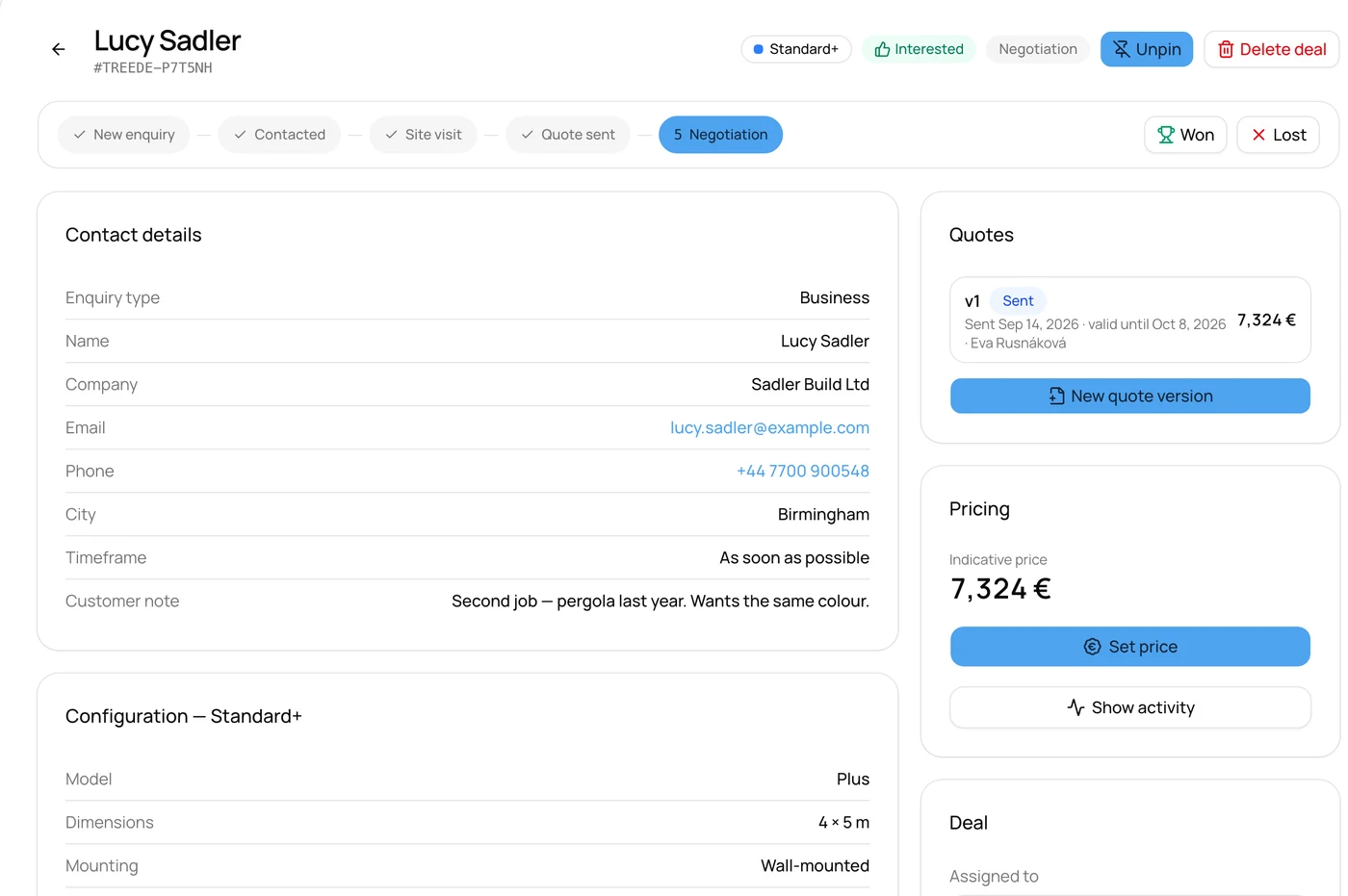
The picture shows a sample enquiry in treede CRM. The names, company and amount are made up.
What quoting software fixes, and what a configurator fixes
Quoting software speeds up the document: the template, numbering, sending and tracking. In made-to-order sales, though, the document is rarely the bottleneck. The brief is.
That's exactly what a configurator deals with. The customer puts the product together from the permitted options, the configurator checks the agreed rules and works out the price from your price list. The salesperson doesn't get a question but a brief with dimensions, options and contact details. With treede, the configuration is saved to treede CRM with its specification, the contact and a link to the design.
A peer-reviewed study of 14 engineering-oriented companies (Haug, Hvam and Mortensen, 2011) found that after a product configurator was deployed, internal quote preparation time fell by an average of 85.5%. It doesn't measure website sales, and any one company's result depends on its product and process. The methodology is in the published study.
How to tell your quotes really got faster
Feeling that "it's quicker now" is nice. Numbers are more precise. Three are enough:
- time from enquiry to quote sent,
- number of questions or emails before the quote,
- number of quote versions per job.
How many hours a month that could win back, you can work out in the readiness checklist from your own numbers. The calculation uses no outside average, only the numbers you enter.
Frequently asked questions
How quickly should you send a quote?
An estimate as soon as possible, ideally on the day of the enquiry if your rules can price it. The firm quote after the site visit. A fast quote without an exact brief only brings the next version sooner.
What should a made-to-order quote include?
The specification, an itemised price, what the price excludes, whether it's an estimate or firm, how long it's valid, the date and a contact. There's a fuller list in step 4 above.
Is Excel enough for quotes?
To start with, yes. Excel is flexible and a good source of rules. It starts to slow you down when several people use it, when versions multiply and when the customer needs to see what they're ordering.
Monday at 7:40, this time with a quote
The coffee stays the same. What lands in the inbox changes: an enquiry with dimensions, model and mounting, an estimate from your own rules, and a clear next step. The first email of the day no longer has to be a list of questions. It can be a quote.
What the whole path from campaign to installation looks like for one client is described in the Moja Pergola case study. And if you're wondering what a configurator with treede CRM costs, the pricing is on the website. No request needed.